William C. Head, P.C.
Atlanta DUI Law Firm



A BAC estimate calculator projects your approximate blood alcohol concentration from the number of standard drinks you have had, your body weight, your biological sex, and the hours since your first drink. It is an estimate only. It is not a chemical test, not a defense to a DUI charge, and not a substitute for the breath or blood testing police use in Georgia. Use the tool below to gauge your risk, then arrange a ride home.

Blood Alcohol Concentration (BAC) is a measurement of the amount of alcohol in a person's bloodstream. This BAC number is expressed as a percentage. For example, a BAC of 0.08% means there are 0.08 grams of alcohol per 100 milliliters of blood.
Law enforcement uses BAC to decide whether a driver is impaired by alcohol. In most states, it is illegal to drive with a BAC of 0.08% or higher for drivers age 21 and over. In Georgia, if your BAC is at or above the legal alcohol limit for your age and license type, you can be arrested for DUI Per Se, meaning that your BAC alone was enough to charge you for driving under the influence. The legal BAC limits in Georgia are 0.08% for drivers over 21, 0.02% for drivers under 21, and 0.04% for CDL holders, or those drivers operating a Commercial Motor Vehicle.
In a real Georgia case, no one relies on a calculator. The State measures blood alcohol content through breath, blood, or urine testing, and Georgia law sets the rules for that chemical testing. The analysis follows methods approved by the Georgia Bureau of Investigation Division of Forensic Sciences. A breath test requires two sequential samples, and those results may not differ by more than 0.020 grams.
Blood alcohol concentration also moves over time. A person can still be climbing toward peak concentration after the last sip, and the body then eliminates alcohol at a steady pace. A stop, an arrest, and a station-house test can take an hour or longer, so the printout is a snapshot taken later. It is not necessarily the number that existed while the car was moving.
A measured BAC comes from a physical sample analyzed under a controlled protocol. An estimated BAC comes from arithmetic applied to figures you type in yourself.

If you are ever stopped on suspicion of DUI, one of the first things an officer will evaluate is your blood alcohol concentration, or BAC. Many people do not realize how easily a "standard drink" can affect that number.
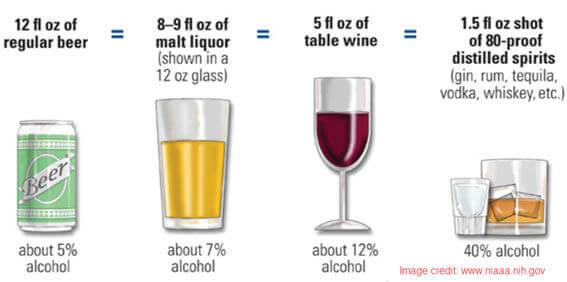
In the U.S., a standard drink contains about 14 grams of pure alcohol, but the alcohol content varies greatly by beverage type. A regular 12-ounce beer typically holds about 5% alcohol by volume (ABV). Malt liquor is stronger, and just 8 or 9 ounces can contain around 7% ABV. A 5-ounce glass of table wine often runs about 12% ABV. Distilled spirits reach roughly 40% ABV, so a single 1.5-ounce shot of 80-proof liquor counts as one standard drink.
Here is the catch. Almost nobody drinks in standard drinks. A craft IPA may run 7% to 9% ABV, which makes one pint closer to two standard drinks. A restaurant wine pour can hold 8 or 9 ounces, not 5. A free-poured cocktail may carry two or three shots with no way to tell.
This is the most common reason a self-estimated BAC lands far below the tested result. The drinker counts glasses, not alcohol. Enter "three drinks" but actually consume the equivalent of five, and the output will be wrong in the direction that gets people arrested.
Several factors influence your blood alcohol concentration, and they interact with each other. The list below covers the ones that move the number most.
Quantity of alcohol ingested. The more alcohol you consume, the higher your BAC will be. This counts grams of pure alcohol, not containers.
Whether food was ingested before or during drinking. Food slows absorption into the bloodstream and can lower your peak reading.
Lean body (muscle) mass. Body composition affects BAC. Estimators approximate it from weight and assume a normal height-to-weight ratio.
Biological sex. On average, women carry a lower proportion of body water than men of the same weight, so the same alcohol spreads into a smaller volume. Differences in alcohol dehydrogenase activity may also affect how much alcohol reaches the bloodstream.
Rate of consumption. The liver eliminates alcohol at a roughly fixed pace. Drinking faster than that pace stacks alcohol up, so four drinks in one hour differ sharply from four drinks over four hours.
Carbonation and mixers. Carbonated mixers and sparkling wine can speed gastric emptying, which pushes alcohol into the small intestine sooner and raises BAC faster.
Medications and health conditions. Some drugs and some metabolic conditions may change how the body processes alcohol.
Time elapsed since drinking began. This is the elimination period. Many people search for a "BAC to zero chart," but the time it takes to return to zero depends on metabolism and an average elimination rate of about 0.015% per hour. If your estimated BAC is 0.167% and four hours have passed, you would subtract about 0.06%, leaving roughly 0.107%.
No calculator can account for all of this variation. That is why two people of the same weight who drink identically can test differently on the same night.
The BAC estimate calculator on this page asks for four inputs: the number of standard drinks consumed, your body weight, your biological sex, and the hours since your first drink. Enter each as accurately as you can, and count alcohol rather than glasses.
Behind the tool is a Widmark-style formula. It spreads the alcohol you entered across the water volume in a body of your weight and sex, then subtracts an average elimination rate for each hour that has passed. Our BAC calculator uses established formulas based on alcohol elimination rates, weight, gender, and drinking duration.
Read the output as a range, not a verdict. If the estimate lands near a legal threshold, treat it as if you are over. The arithmetic assumes an average person.
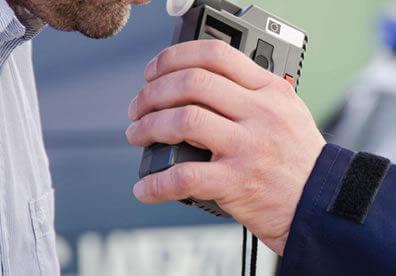
Here is what the BAC estimate calculator cannot do. Its results are approximations that may vary with food, medication, drinking pace, and metabolism. A low reading does not make it lawful or safe to drive. Georgia may prosecute a driver who is under 0.08, so a number below the limit is not clearance. A calculator output is also not a way to contest a breath or blood result in court.
The safe use of this tool is planning. Run it before you go out, run it again before you think about driving, and if there is any doubt, do not drive.
The chart for blood alcohol level below provides a visual reference for how BAC may change based on body weight and the number of drinks. This blood alcohol content chart is a useful complement to the calculator above.
Reading it takes three steps. Find the row that matches your body weight. Read across to the column for the number of standard drinks you consumed within about one hour. Then subtract roughly 0.015% for each hour since you started drinking.
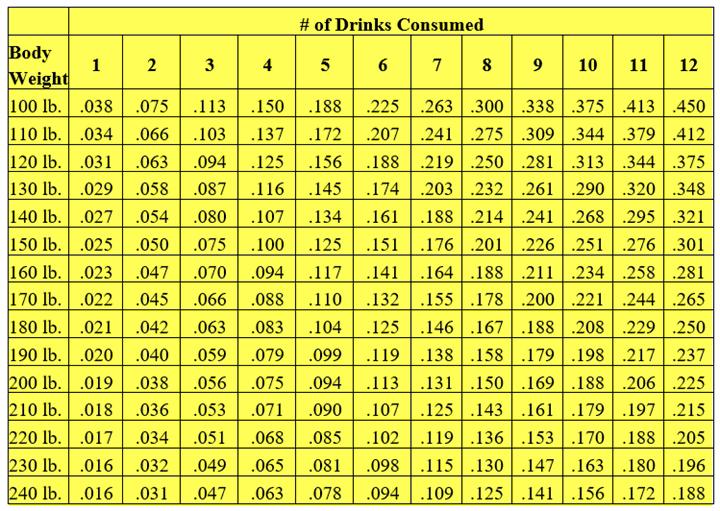
A common question is: how many drinks does it take to reach 0.08? For many adults, two to three standard drinks consumed quickly may result in a BAC at or above the legal limit. That varies with body weight, biological sex, food, and pace. A smaller person drinking on an empty stomach can cross 0.08 on two drinks.
Charts carry the same assumptions as calculators. They assume true standard drinks and average metabolism, so they read low for anyone drinking craft beer, oversized pours, or free-poured cocktails.
A chart figure and a tested figure diverge for a simpler reason too. The chart estimates from what you told it. The test measures what is actually in your body.
People search for individual numbers because a number is what they were handed. Here is what the common readings mean, both as impairment and as Georgia law.
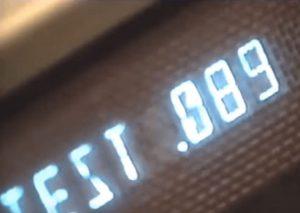
0.02 is Georgia's threshold for drivers under 21. Most people feel little at this level, though some loss of judgment may occur. For an underage driver, it is enough to support a criminal DUI charge.
0.04 is the commercial threshold. A CDL holder operating a commercial motor vehicle faces license consequences at this level, and coordination may begin to slip.
0.05 commonly brings reduced coordination, slower tracking of moving objects, and lowered alertness. Georgia's adult per se limit is not set here, but an officer may still build a less safe case.
0.08 is the adult per se threshold. Muscle coordination, balance, reaction time, and judgment are typically impaired, and short-term memory may suffer.
Above that point the effects compound. A .15 alcohol level often brings substantial loss of balance and vomiting. A .18 alcohol level is generally associated with disorientation and confusion. A .21 alcohol level usually adds difficulty walking without help. A .23 alcohol level may produce blackouts and stupor. A .27 alcohol level can leave a person unable to guard against injury. Readings at 0.30 and above are a medical concern rather than only a legal one, because loss of consciousness and alcohol poisoning become serious risks.
Now the legal accuracy point, because bad information circulates here. Georgia has no statutory "aggravated DUI" or "high BAC" penalty tier. Georgia's DUI penalty ranges turn on how many prior offenses a driver has within ten years, measured arrest date to arrest date, not on how high the reading was. A second DUI in Georgia carries steeper minimum penalties than a first, whatever the number on the printout. You will see pages claiming that 0.16 doubles the punishment. That is not Georgia law.
One verified consequence is tied to a number. Under Georgia law, a nolo contendere plea to DUI is unavailable when the alcohol concentration was over 0.15. Beyond that, prosecutors and judges commonly treat an elevated reading as an unfavorable fact at sentencing, but that is discretion, not a statutory tier.
Georgia DUI laws set the legal blood alcohol content for driving by driver category: 0.08% for drivers 21 and older, 0.02% for drivers under 21, and 0.04% for commercial drivers holding a CDL. Those limits come from Georgia's driving under the influence statute.

What most readers miss is that the statute has two alcohol prongs, and only one involves a number. Under the per se prong at subsection (a)(5), the State must prove an alcohol concentration of 0.08 grams or more at any time within three hours after driving ended, from alcohol consumed before driving ended.
The less safe prong at subsection (a)(1) requires no particular number at all. The State must prove the driver was under the influence of alcohol to the extent it was less safe to drive. Officer observations, driving behavior, field evaluations, and video can carry that burden with no chemical test result at all.
This is why a calculator reading below 0.08 does not put a driver in the clear. A jury may convict on the less safe prong at 0.06, or with no number whatever.
For what an elevated reading actually changes in Georgia, see the section above on specific BAC numbers.

Most people who drink alcohol and drive never check a blood alcohol content chart or an online calculator to know their legal limit. Many mistakenly believe they can judge whether they are "over the limit" based on how they feel. This false sense of confidence is one of the main reasons DUI arrests are so common.

The sequence usually starts with a traffic stop or a sobriety checkpoint. The officer notes what he sees and smells, then asks questions designed to produce admissions about drinking. Roadside field sobriety evaluations may follow, and those evaluations are voluntary.
If the officer makes an arrest, he then reads the implied consent notice. Under Georgia's implied consent statute, that notice follows an arrest for a DUI offense, or involvement in a traffic accident with serious injuries or fatalities. It designates the state-administered chemical test of blood, breath, or urine.
Read the refusal language carefully. The statutory notice states that refusal to submit to blood or urine testing may be offered into evidence against you at trial. A refusal still carries a license suspension of at least one year, and it is a major violation for a commercial license holder. The U.S. Supreme Court upheld implied consent schemes in Birchfield v. North Dakota (2016).
A driver who takes the state test also has the right to an independent test, performed by a physician or other qualified person of the driver's own choosing, at the driver's own expense.
A separate track opens at the same moment. The officer's paperwork, the DDS 1205 form, starts an administrative license suspension through the Georgia Department of Driver Services. That administrative case is not the criminal case, and its outcome does not decide the DUI charge.
The deadline is 30 days from the notice, and it is 30 days in Georgia, not 10. Within that window a driver may send a written hearing request to DDS with the $150 filing fee under Georgia law. The alternative is an ignition interlock device limited permit, which requires an affidavit waiving that hearing. Doing neither lets the suspension take effect.

For adult drivers age 21 and over, 0.08% is the legal limit in nearly every state and the District of Columbia. At least one state has gone lower, and Utah has used 0.05%, so the shorthand that the limit is 0.08 everywhere is no longer exactly right.
Underage limits vary more, ranging from 0.00% to 0.02% depending on the state. Some states use a true zero-tolerance figure. Others set 0.01% or 0.02% to accommodate the margin of error in breath testing equipment. Georgia sits at 0.02%.
One threshold does not vary. The federal limit for commercial motor vehicle drivers is 0.04 BAC. Federal rules also place a CDL driver found with any trace of alcohol out of service for at least 24 hours, called an out-of-service order.
Implied consent rules differ by state as well. Refusing the official state-administered test after a lawful DUI arrest carries a license suspension or revocation everywhere, and some states attach criminal exposure to the refusal itself.
One rule matters more than all of that detail. You are prosecuted under the law of the state where the driving happened. A visitor arrested in Georgia is charged under Georgia law, whatever the rules are back home.
Only time lowers your BAC. The liver eliminates alcohol at a roughly fixed rate, and nothing you do speeds that rate up in any meaningful way.
Coffee and caffeine do not help. They may make a person feel more awake while the alcohol concentration stays exactly where it was. A cold shower does the same thing.
Exercise and sweating do not work either. Only a tiny fraction of alcohol leaves through breath, sweat, and urine, and the liver handles the rest on its own schedule. Drinking water helps with dehydration but does not dilute alcohol already in the bloodstream. Hyperventilating before a breath test is not a strategy.
Food eaten before or during drinking is the one real variable. It slows absorption and can lower your peak concentration. Eating after the fact does not undo alcohol that has already absorbed.
That is the trap in all of these myths. Every one of them changes how alert a person feels while leaving the actual number essentially unchanged. Feeling sober is not the same as being under the limit.
A test result is not automatically admissible, and the number on a printout is not the end of the analysis. The testing procedure, the instrument's maintenance history, the officer's training, and the implied consent advisement can all be examined. Acting early matters, because the 30-day license deadline runs whether or not a driver has hired anyone.
William C. Head, PC focuses its practice on Georgia DUI defense. William C. "Bubba" Head is board certified in DUI defense law by the National College for DUI Defense, the sole organization the American Bar Association accredits to certify lawyers in that field. Cory Yager served as a police officer in Cobb County and Roswell and administered the same field sobriety evaluations drivers are asked to perform. Larry Kohn has practiced since 1996, and his client reviews are posted publicly. Together the firm's attorneys bring over 90 years of collective legal practice defending Georgia drivers.
When choosing any lawyer, look at that lawyer's DUI-specific training and courtroom experience rather than at attorney ratings alone. Our library explains how to beat a DUI in court, including how a breathalyzer result or a blood alcohol test may be challenged. No attorney can promise a particular outcome, and results depend on the facts of each case. Call 404-567-5515 for a free consultation about your test and your deadlines.

A BAC estimate calculator gives an approximation, not a measurement. It applies an average elimination rate to the inputs you provide, so its accuracy depends on how precise those inputs are. Food, drinking pace, medication, and metabolism may all push the real figure higher or lower. Treat any result near a legal threshold as if you are over it.
Both are elevated readings, and the legal difference is smaller than most people assume. A .18 alcohol level is more than twice the adult per se limit, and a .15 alcohol level is a little under twice. Georgia does not impose a separate statutory penalty tier at either figure. The one verified rule is that a nolo contendere plea to DUI is unavailable when the reading was over 0.15, which captures both numbers.
For many adults, two to three standard drinks consumed within about an hour may reach or exceed 0.08. Body weight, biological sex, food, and drinking pace all shift the result, and a smaller person drinking quickly on an empty stomach can get there on two. Because real pours are often larger than a standard drink, many people reach 0.08 sooner than they expect.
Georgia sets 0.08% for drivers 21 and over, 0.02% for drivers under 21, and 0.04% for commercial drivers in a commercial motor vehicle. Those figures define the per se offense. Georgia may also charge a driver under the less safe prong with no number at all, so staying below the limit does not put a driver in the clear. An attorney can review how the limits apply to your facts.
No. Time is the only thing that reduces blood alcohol concentration, because the liver eliminates alcohol at a roughly fixed rate. Coffee, cold showers, exercise, water, and food eaten afterward may change how alert you feel, but they leave the actual concentration essentially unchanged. That mismatch is what leads people to drive when they should not. If there is any question, arrange another way home.