William C. Head, P.C.
Atlanta DUI Law Firm




By Cory Yager and Larry Kohn. Cory Yager is a former police officer and a Georgia DUI defense attorney. Larry Kohn is a traffic ticket lawyer who has practiced in Atlanta for more than two decades.
Georgia does not have a single "legal alcohol limit." The per se BAC threshold under Georgia's DUI alcohol limits depends on the driver's age and vehicle type. Standard adult drivers face a 0.08 grams percent limit. Drivers under 21 face a near-zero-tolerance standard of 0.02 grams percent. Commercial motor vehicle operators can be charged at just 0.04 grams percent. This page explains each threshold. It covers how Georgia's official breath testing works. It addresses what happens if you refuse a test. It also shows how probation alcohol testing – including ETG urine tests – is not the same as the per se driving limits.
This section covers the legal breathalyzer limit and the blood alcohol level legal limit. Both numbers are the same for the three main groups of drivers on Georgia's roads.
When drugs other than alcohol are suspected, a drug test can pick up street drugs and prescribed drugs alike. Over-the-counter drugs, marijuana, and man – made drugs can also be found. That testing is done at a different section of the Georgia Bureau of Investigation.
The next section covers the three legal blood alcohol numbers for driving. Nearly every state in the country uses these same three tiers. Other states set their underage zero-tolerance limits in their own way. A small number have set an adult limit lower than 0.08.

The Georgia alcohol limit for drivers under age 21 is 0.02 grams percent. Georgia does not use 0.00 as its BAC level. That 0.02 reading is the zero-tolerance rule in Georgia for drivers not yet age 21. A driver under 21 breaks it at 0.02 grams or more within three hours of driving.
Georgia's breath testing law requires the state to request two sequential breath samples. Both samples must be requested when the state selects breath testing and the arrest occurs on or after January 1, 1995.
For samples to be admissible in the state's case or the plaintiff's case, the readings cannot differ by more than 0.020 grams. The lower of the two results controls for accusation, indictment, and administrative license suspension purposes.
Before that 1995 date, the old rule let a single alcohol breath test come in as evidence in a drunk driving case. The Division of Forensic Sciences of the Georgia Bureau of Investigation approves the techniques and methods used for breath testing. It also publishes the list of approved evidential breath testing instruments. Under its implied consent rules, the Intoxilyzer 9000 is approved for breath tests conducted on or after January 1, 2013. The older Intoxilyzer 5000 is approved only for tests conducted on or before December 31, 2015. Georgia phased the changeover in over those three years. Since the end of 2015, the 9000 has been the state's only approved evidential instrument. Which machine tested a given driver still matters to the defense. Operator permits are tied to one instrument. A permit to run the 5000 did not let its holder run the 9000. Breath testing devices show a wider spread between the two samples when they estimate your breathalyzer legal limit. Blood testing by GC – MS – MS or LC – MS – MS is more exact than any Intoxilyzer reading in Georgia.
For commercial driver license holders behind the wheel of a commercial motor vehicle, the threshold is stricter at 0.04 grams percent. If testing shows any alcohol at all, the driver is given an out-of-service order and cannot drive a commercial vehicle for 24 hours. Refusing the state's test after arrest instead disqualifies the driver from driving a commercial vehicle for a minimum of one year. Either way, the vehicle can be left stranded.
Georgia DUI laws presume that being at or over those BAC legal limit "numbers" is per se DUI. The Legislature has decreed that it is not safe for the person to drive or operate a motor vehicle in Georgia at that level. This standard – less safe to drive by alcohol – has a matching standard for drugs called "incapable of driving safely."
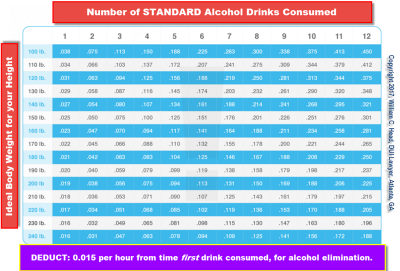
A blood alcohol level test can be done with a breath machine, or with blood and urine testing. The second method is used when drugs other than alcohol are involved. The drinking limit in Georgia for each type of driver was also covered. The chart below is a rough estimate based on lean body weight of the driver.
Note: This is a male chart. A female of the same weight as a male would reach higher BAC levels with less alcohol. The female body has more adipose (fat) tissue.
To read the chart, find your weight and then the number of drinks. The number you land on is only a rough guide. Food, time, body size, and how fast you drank all move the real number up or down. No chart can tell you what a breath machine will read on the night of a stop.
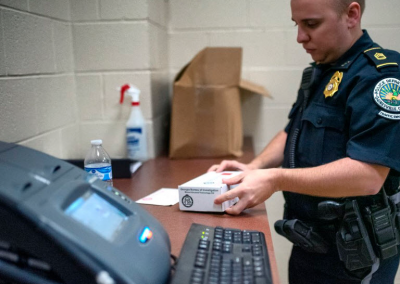
A legal breathalyzer test in Georgia is an evidentiary breath test. It is run on a state – approved device by a certified operator. In 2026, the only approved evidentiary breath testing machine in Georgia is the CMI Intoxilyzer 9000.
Under Georgia's chemical testing law, a breath test must use methods approved by the state's Division of Forensic Sciences. The machine must also be in proper working order. All electronic and operating components must be properly attached. The operator must hold a valid permit issued by the Division of Forensic Sciences of the Georgia Bureau of Investigation.
Drivers often confuse the roadside portable breath test (PBT) with the Intoxilyzer 9000 test. The PBT is sometimes called an alco – sensor. The PBT is a handheld screening device. Officers use it during a traffic stop to develop probable cause. PBT results are generally not admissible as evidence of an exact BAC number in Georgia courts.
The Intoxilyzer 9000 test is given after arrest. It produces the BAC reading that prosecutors may use at trial.
Georgia is an implied consent state. Under Georgia's implied consent law, driving on Georgia roads means you have consented to chemical testing. That consent applies when you are arrested for DUI. It also applies when you are in a traffic accident that causes serious injuries or a death. Testing can involve blood, breath, urine, or other bodily substances.
When the test is requested, the arresting officer must select and read the implied consent notice that matches the driver. There is one notice for suspects under 21, one for suspects 21 or over, and one for commercial drivers. The notice states that refusal will result in a license suspension for a minimum of one year. The notice also advises you of the right to an independent test at your own expense after submitting to the state's test.
Refusing to submit may lead to an administrative license suspension. The officer will take your license and give you a 45 – day temporary driving permit. The license is then forwarded to the Department of Driver Services. You have a limited window to request an administrative hearing to challenge the suspension.
Several requirements must be met for a legal breathalyzer test result to be admissible. The operator must hold a valid GBI permit. The operator must be trained on the specific Intoxilyzer 9000 model used. The device must be in proper working order. All manufacturer – prescribed components must be attached.
Georgia law requires the state to request two sequential breath samples. The two readings cannot differ by more than 0.020 grams. The lower of the two results controls for charging and license suspension purposes.
A standard 20 – minute observation period before the test helps make sure mouth alcohol does not taint the sample.
A breath test result is not proof that cannot be fought. Defense attorneys may challenge the test on several grounds.
Expired or missing calibration records can cast doubt on how well the device works. If the operator's GBI permit was expired, the result may be thrown out. The same is true if the operator lacked training on that exact machine.
Medical conditions can cause falsely high readings. Acid reflux disease (GERD), diabetes, and a low – carb diet that makes ketones are all on that list. Dental work can affect results too. So can mouth alcohol left in the mouth after a recent swig of mouthwash.
A Georgia DUI attorney can review whether the test in a given case followed the law.
A probation officer is assigned to oversee any person on a probated sentence. That officer checks that you follow every term. It lasts for the whole probation period. Once on probation, sentencing orders in Georgia drunk driving cases often impose a "zero" tolerance condition. Under that condition, you cannot have any psychoactive substance in your system unless it is lawfully prescribed. You also cannot show its burn – off products.
If sentenced under a DUI court program or Drug Court program, most offenders have a second offense or more. Georgia's DUI statute sets a minimum of 30 days of community service for a second or third DUI within ten years. A fourth or later DUI in that period carries a minimum of 60 days of community service. The judge may suspend that service only for a defendant sentenced to serve three years of actual imprisonment.
The most common testing type is ethyl glucuronide or "ETG" tests. These are screening tests. They can flag either the parent drug or chemical, or the "burn – off" products of that drug. Those burn – off products are what the liver turns the drug into.
Under the probation conditions Georgia courts impose, two things can trigger a probation violation. One is a positive "presumptive" test for a banned drug category. The other is a positive ETG test for alcohol. The same applies if the test shows dilution or comes back with high numbers – over the department's posted dilution levels. Cutoff levels turn a reading into a violation. They vary by testing program. Our guide to what is considered heavy drinking for an EtG test explains the common cutoffs and how long the marker stays detectable after drinking.
ETG readings have nothing to do with the legal limit for driving. They are separate from a legal limit alcohol "number." Probation conditions in these cases bar drinking alcohol in any form. When a test shows a threshold level of markers from prior use, part of that sample is sent to a medical lab. It goes by overnight shipment for a confirming test. Once the lab backs up what the first test showed, the person on probation faces sanctions such as jail time.
Where the sentence orders testing, Georgia probation officers choose which test to give. Urine is the usual pick. They use it to check for broken probation rules. Random tests are standard with DUI probation in the state of Georgia. When people report for their regular probation visits, they are told to expect a test. Those scheduled samples come on top of random testing. The tests can be of your blood, breath, saliva, hair follicle, or urine.
The probation officer does not need any reason for the test. They do not have to suspect that you were drinking or smoking marijuana. They can test you at their own discretion.
If you fail a drug or alcohol test by testing positive for marijuana or alcohol, the judge can sentence you to serve jail time. The judge decides how much jail time you would serve.

Most people on probation want to know what all of this looks like week to week. The routine is simple. You report when your officer tells you to report. You hand over the sample they ask you to give. Then you wait on the result. A urine screen is the test you will see most often, and it is almost always done on site. Even so, the details matter, and they are where most people get tripped up. The rest of this section walks through those details. It covers how often random tests are ordered and what an ETG screen picks up. It also covers why a person who never drank can still fail one, and what happens after a positive result. Read it before your next check – in so that nothing catches you off guard.
How often random tests come depends on the sentencing court and the level of supervision. Standard DUI probation may require a test at each monthly check – in, plus random calls with no notice. DUI Court programs often test far more often – sometimes several times a week. That is most true in the early phases of the program.
A probationer may get a call or text telling them to report for a test within hours.
An ETG (ethyl glucuronide) test looks for a marker the liver makes when it breaks down alcohol. A breath test measures current impairment. By contrast, an ETG test can show drinking that happened roughly 24 to 80 hours before the sample was taken.
The detection window depends on how much a person drank. One drink may leave a marker for about 24 hours. Heavy drinking could show up for three days or longer.
ETG tests are so sensitive that they can flag alcohol a person never drank. Hand sanitizer with alcohol in it, some mouthwashes, kombucha, a few fermented foods, and even cleaning products can push ETG readings up.
Tell your probation officer about any medicine or product you use before a test. A second test sent to a lab can help tell real drinking apart from stray contact.
Some Georgia DUI Court programs require participants to wear a SCRAM (Secure Continuous Remote Alcohol Monitor) ankle bracelet. This device tests sweat for alcohol every 30 minutes, day and night. It watches all the time instead of taking spot checks.
A confirmed alcohol reading from a SCRAM device may bring quick sanctions. Courts in Fulton, DeKalb, Cobb, and Gwinnett counties have all used SCRAM monitoring in DUI Court cases.
A confirmed positive result starts a probation violation process. That is true whether it came from urine, breath, or a SCRAM device. The probation officer files a petition with the sentencing court. You are entitled to a hearing where the judge reviews the evidence.
Depending on the facts, sanctions may include more jail time, longer probation, more frequent testing, required treatment, or full revocation of probation. The outcome depends on the facts and the sentencing judge's discretion.
A BAC reading from the breath machine can feel like proof you cannot beat. These results are not beyond challenge. Georgia DUI defense asks whether the test was lawfully obtained and correctly run.
The operator who gives the breath test must hold a valid permit from the GBI Division of Forensic Sciences. The operator must also be trained on the exact model used. The implied consent notice must be read in full before testing. The officer need not read it word for word, so long as its substance is unchanged.
Maybe the officer failed to watch you for the required pre – test waiting period. If so, mouth alcohol left from before could have tainted the result. Any break from proper procedure may give grounds to keep the result out of evidence.
The breath machine must be run with all manufacturer – prescribed components properly attached and in good working order. Defense attorneys routinely ask for calibration records, maintenance logs, and inspection records.
Gaps in calibration schedules or logged breakdowns can cast doubt on the BAC reading. The device's source code and software version may also matter.
Some medical conditions can push breath test results too high. GERD and acid reflux may push stomach alcohol vapors into the mouth. Diabetes and strict low – carb diets can make the body produce acetone through ketosis. Some breath testing devices may read that acetone as alcohol.
Dental work such as bridges, crowns, or dentures can trap alcohol in the mouth. These factors do not void a test on their own. They may still raise reasonable doubt about how accurate the reading is.
Before a breath test ever happens, the officer must have had a lawful basis for the traffic stop or checkpoint. If the stop lacked reasonable articulable suspicion, the breath test evidence may be subject to a motion to suppress. If a DUI checkpoint did not follow constitutional requirements, the evidence may also be challenged.
A Georgia DUI attorney who knows Fulton, DeKalb, Cobb, and metro – Atlanta courts can review whether the stop or the checkpoint was lawful in your case.
For more detail on Georgia BAC testing, see our pages on DUI blood alcohol level, what DUI blood tests check for, and the Georgia DUI BAC chart.
Many people search for "random breath test" to find out one thing. Can Georgia police pull over any driver at random and demand a breath sample? The answer is no for routine traffic stops. Courts in the United States have not approved the kind of truly random roadside breath testing used in countries such as Australia.
Under the Fourth Amendment, an officer needs reasonable articulable suspicion to make a traffic stop. The officer must be able to point to something specific and objective. Weaving, running a red light, speeding, or an equipment violation are examples. An officer cannot stop a driver on a hunch or at random.
Once stopped, the officer needs probable cause to believe you are impaired before asking for an official breath test. A random breath test without any suspicion of wrongdoing would violate constitutional protections.
DUI sobriety checkpoints are legal in Georgia. The United States Supreme Court decision in Michigan Dept. of State Police v. Sitz established this authority. Georgia case law generally requires checkpoints to follow set rules.
Supervisors must pick the location ahead of time. A neutral formula must decide which cars stop, such as every third car. A supervisor must approve the plan. Brief detention of each stopped driver is allowed. At a checkpoint, an officer may talk with the driver and look for signs of impairment.
The officer may then develop suspicion – say, the smell of alcohol or slurred speech. At that point the officer may request field sobriety tests or a preliminary breath sample. The checkpoint itself is lawful, but the breath test request still requires individualized suspicion.
The one context where truly random breath testing does occur in Georgia is probation. As shown above, people on probation and DUI Court members consent to random testing as a condition of their sentence. Where the sentence imposes that condition, a probation officer can require a breath, urine, or other test at any time without suspicion.
This is a very different legal setting from a traffic stop. The probationer has already been convicted and is serving a sentence under court supervision.
A Georgia drunk driving charge carries serious consequences. A conviction may result in license suspension, mandatory fines, jail time, community service, a DUI Risk Reduction Program, and sharply higher insurance premiums. These penalties increase with each subsequent offense within a ten – year period.
Time matters. Georgia law gives drivers a limited window to request an administrative license suspension hearing after a DUI arrest. The sooner an attorney reviews how the breath test was run, how implied consent was handled, and the facts of the stop, the more options may be available.
William C. Head, PC concentrates on Georgia DUI defense and is familiar with courts throughout Fulton, DeKalb, Cobb, and Gwinnett counties.

Yes. Georgia's implied consent law deems every driver to have consented to chemical testing when arrested for DUI. You can refuse the test. Refusal carries its own consequences. Your license will be suspended for a minimum of one year unless the suspension is rescinded after an administrative hearing. A refusal of blood or urine testing may also be offered against you at trial.
The arresting officer must read you the implied consent notice before requesting the test. A Georgia DUI attorney can advise you on how refusal may affect your own case.
No, officers cannot give a random breath test at a traffic stop. Officers need reasonable articulable suspicion to stop your car. They also need probable cause to believe you are impaired before asking for an official breath test. Georgia does not allow truly random breath testing during routine traffic stops.
At a DUI checkpoint, officers may briefly stop cars under a neutral selection plan. Still, they need individualized suspicion before requesting a breath sample. Random testing without suspicion occurs only during DUI probation or DUI Court supervision.
Under Georgia's zero-tolerance rule for young drivers, drivers under age 21 face a BAC limit of 0.02 grams percent. That near – zero – tolerance standard means even one drink could push a young driver over the legal limit. A first or second conviction is a misdemeanor. A third or subsequent conviction is a high and aggravated misdemeanor with increased penalties.
The Intoxilyzer 9000 is the only state – approved evidentiary breath testing device in Georgia. The device is seen as reliable when it is properly kept up and run. It is not perfect. Expired calibration, operator error, medical conditions like GERD or diabetes, and leftover mouth alcohol can all affect accuracy.
Georgia law requires two sequential breath samples that must agree within 0.020 grams. The lower reading is used for charging purposes. Defense attorneys may challenge the result based on device records, operator credentials, or body chemistry.