William C. Head, P.C.
Atlanta DUI Law Firm



PBT stands for preliminary breath test. Officers also call it a portable breath test. The device is a small handheld breath-alcohol screener. A Georgia officer may offer it at the roadside, before any arrest decision. A pbt alcohol test screens for the presence of alcohol. The handheld is not the official breath test given later at the police station.
Drivers charged with DUI in Georgia often ask why they had to blow twice. A Georgia DUI case can involve two very different breath tests. The first is the pre-arrest handheld PBT at the roadside. The second comes after the arrest. That one is the state-administered evidentiary breath test. Police usually run it on an Intoxilyzer 9000 at the station or jail.
One point drives this page. In Georgia, the number a roadside handheld device displays cannot prove a driver's blood alcohol level. Under Georgia law, a roadside screening result is admissible only on the question of whether alcohol was present or absent. Chemical testing after a DUI arrest follows strict rules set by statute. Georgia law sets those rules. The roadside screener sits outside them.
The roadside device is not the cheap gadget sold online. These are police-grade instruments. They cost $800 to $1,500. Georgia still does not treat their readings as proof of a breath alcohol number.
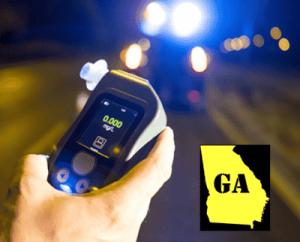
PBT stands for preliminary breath test. Officers and agencies also say portable breath test. Both labels mean the same device. Searchers who type what does pbt stand for police reports use are looking at those two labels. The terms are interchangeable in Georgia practice. Reports may also call the device a roadside screening device, a handheld, or an Alco-Sensor.
The pbt test meaning is simple. The handheld is a screening device, not a measuring instrument of record. The device answers one narrow question for the officer standing at the roadside. Does this person's breath contain alcohol, yes or no.
In pbt law enforcement practice, that yes-or-no answer is one input among several. The officer also weighs the driving and the driver's statements. Appearance, the odor of alcohol, and the standardized field evaluations count too. The handheld does not replace any of that. The screening result feeds the probable-cause decision at the end of the roadside stop.
The contrast is worth stating plainly. The handheld is a screening tool. Only the state-administered test yields a number the State can put before a judge or jury. Police give that test after a lawful arrest.
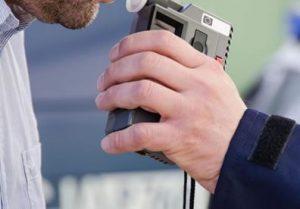

Georgia approves handheld screening devices for roadside use, including the Alco-Sensor family of instruments. These are non-evidential breath alcohol testers. That classification matters. The officer may report only one thing. A driver who agreed to the test showed a positive or a negative result for alcohol.
The preliminary breathalyzer test, as police often call it, is portable and simpler than the station instrument. Police use it to help build probable cause to arrest a driver they suspect of driving under the influence. These devices skip the reliability inspections the Intoxilyzer 9000 must pass. They also do not print a result. So a pbt alcohol test is not an evidential measure of blood alcohol content.
Georgia's chemical test statute governs the state-administered test given after arrest. Georgia law covers approved testing methods, the two-sample breath rule, and the right to an independent test. It sets no rule for roadside screening devices. Georgia law handles the handheld separately. The result of a roadside alcohol screening test may be offered only on the question of whether alcohol was present. The number the handheld displays cannot prove blood alcohol concentration.
That limit comes from Georgia law and from Georgia court decisions on roadside screening devices, not from the text of the chemical test statute. Georgia appellate courts have applied it strictly. They have held that a preliminary breath test number cannot be admitted. That holds even at a pre-trial motion hearing. At such a hearing the judge decides only whether the stop and arrest were lawful. The officer may testify that the screening test was positive for alcohol. The officer may not tell the court what the small screen said.
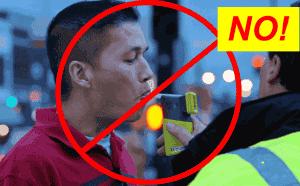
Police give both tests. But the two sit at different stages of a case and carry different legal weight. The breathalyzer test chart below compares them side by side.
| Question | Roadside PBT (Handheld) | State-Administered Test (Intoxilyzer 9000) |
|---|---|---|
| What the device is | Small handheld fuel-cell screening device | Evidentiary breath-testing instrument kept at a station or jail |
| When it is given | Before arrest, during the roadside investigation | After a lawful DUI arrest |
| Where it happens | At the scene of the stop | Police station, jail, or a mobile testing unit |
| What the officer may report | Only that alcohol was present or absent | The numeric breath alcohol result |
| Can the number prove blood alcohol concentration? | No | Yes, if the State lays the required foundation |
| Is it voluntary? | Yes, the driver may decline | Requested under Georgia's implied consent notice |
| If the driver declines | Not the implied consent refusal, and not a basis for license suspension | Refusal can suspend the license for at least one year through the Department of Driver Services |
This chart does not tell you how much you can drink. Some charts map drinks, body weight, gender, and time elapsed to an estimated blood alcohol level. No such chart can tell a person that they are safe or legal to drive.
Georgia's DUI statute also holds two separate alcohol prongs. The first is driving under the influence less safe. Under that prong the State claims alcohol made the driver less safe to drive, whatever the number was. The second is the per se charge. It applies when a chemical test shows 0.08 grams or more at any time within three hours after driving ended. Under Georgia law, a reading below 0.08 does not end the case.
Drivers worried about a post-arrest test result can review how a defense attorney may challenge breath test results in a Georgia DUI case.
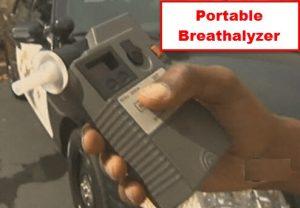
The roadside handheld screening test is a field test. A driver in Georgia may decline it. Many drivers assume that saying no costs them their license on the spot. That assumption is wrong.
Declining the roadside handheld test is not the implied consent refusal. The two are different events at two different points in the case. The implied consent request comes after a lawful DUI arrest. At that point the officer reads the statutory notice. The officer then asks for a breath, blood, or urine sample designated by the State. Refusing that state-administered test is what carries driver's license consequences through the Department of Driver Services. More detail sits on our page about how Georgia's implied consent law works.
One practical wrinkle follows. A driver may blow into the handheld and register no alcohol at all. An officer who still suspects impairment may then seek a blood or urine test. That step explores a DUI-drugs theory. A negative alcohol screen does not always end the roadside stop.
The license clock matters. A DUI arrest can trigger an administrative license suspension. The driver then has a 30-day window to act. One route is a written hearing request to the Department of Driver Services, with the $150 filing fee. The other route is an ignition interlock limited permit, elected within those same 30 days. That election waives the hearing. Not everyone qualifies for the permit. Doing nothing lets the suspension take effect. The deadline in Georgia is 30 days, not 10.
As general information rather than advice, drivers who prefer not to test may decline politely and ask to speak with a lawyer.

Two questions come up constantly. How do breathalyzer tests work, and how does a breathalyzer detect alcohol. The answer depends on which device is in front of you. Georgia's two breath tests use different technologies.
Portable breath machines are simple next to an infrared spectroscopy device. Every Georgia preliminary breath test machine uses a fuel cell. That fuel cell is a basic electrochemical detector. The coating sits on one side of a small plate about the size of a dime. Alcohol molecules in the breath react at that plate. A software algorithm counts the molecules that stick. The device then displays a numeric result. Officers are not supposed to state that number or show it on camera. More alcohol molecules at the plate means a higher reading. A narrow plastic tube leads to the sample chamber. About 5 seconds of forcible blowing is all the test needs.
The evidentiary instrument used after arrest works on a different principle. Infrared spectroscopy measures how much infrared light a breath sample absorbs. The instrument reads wavelengths characteristic of ethanol. More absorption is designed to mean more alcohol in the sample. Two technologies, two error profiles, two legal statuses.
Both designs share one goal. Each tries to reach deep lung air. A breath instrument does not want the air in your mouth. The target is alveolar air that has equilibrated with blood in the lungs. That is why the officer asks for one long, continuous breath.
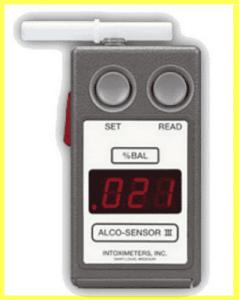
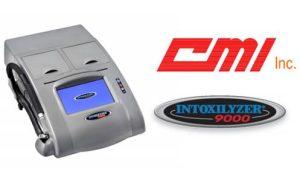
Any honest look at alcohol breathalyzer accuracy starts with one fact. A breath test does not measure blood alcohol at all. The device measures alcohol in exhaled breath. A fixed partition ratio then converts that figure into an assumed blood concentration.
That ratio is an average. The same figure does not fit every person, or one person at every moment. That gap explains why the blood alcohol level vs breathalyzer comparison can yield two different numbers from the same body.
Several recognized variables can push a breath reading away from a person's true blood alcohol level:
Georgia law builds safeguards into the state-administered test. Under Georgia law, the breath test takes two sequential adequate breath samples. The two results must not differ by more than 0.020 grams. The analysis must use methods approved by the Division of Forensic Sciences of the Georgia Bureau of Investigation. The person tested also holds a further right. That right is an additional independent chemical test by a physician or other qualified person of their own choosing, at their own expense.
Those safeguards create records that can be examined later. An attorney who focuses on DUI defense reviews the device's calibration and inspection records. The operator's certification matters too. So does whether the testing procedure matched the training. Roadside handhelds can be calibrated with an aerosol tester. Whether that was done is a fair subject for cross-examination. None of this guarantees a result. The list simply describes what may be reviewed.
Most Georgia DUI investigations begin with an ordinary traffic stop. The reason is often a moving violation or an equipment problem. Others start at a sobriety checkpoint. Some start when an officer approaches a person sitting or sleeping in a parked car or pickup truck.
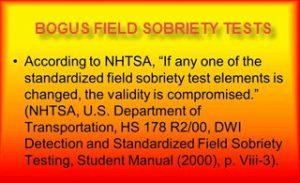
Officers are trained to offer the standardized field sobriety tests first. The training manual comes from the National Highway Traffic Safety Administration. These three evaluations are voluntary. The battery is the Horizontal Gaze Nystagmus (HGN), the Walk-and-Turn, and the One-Leg-Stand. The handheld screening test usually comes at the end of that sequence, right before the arrest decision.
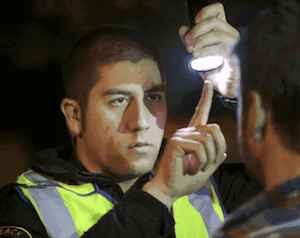
An officer giving the HGN test asks you to follow an object with your eyes. That object may be a pen, a finger, or something similar. The officer moves it from side to side. The officer watches for horizontal gaze nystagmus. That term means an involuntary, rhythmic jerking of the eyes. Nystagmus has causes unrelated to alcohol. Fatigue, stress, certain medications, and some medical conditions can all produce it. The value of the test as evidence turns on whether the officer gave it exactly as trained.
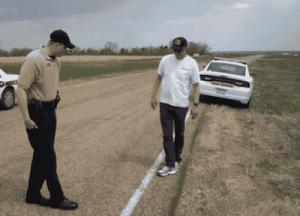
The Walk-and-Turn, or WAT, is built to divide your attention. The test also rates balance, coordination, and the ability to follow instructions. Alcohol supposedly harms those skills. But consider the reality. Who walks a straight line, heel-to-toe, for nine steps? Who holds both arms stiff at their sides the whole way? Who then turns with an awkward, unnatural pivot and walks back nine more steps on that same invisible line?
This field sobriety test asks you to balance on one leg. The raised foot stays about six inches off the ground. Both arms stay tightly at your sides. You count out loud at the same time: one-one-thousand, two-one-thousand, three-one-thousand. The count runs until you reach 30 seconds. All three roadside evaluations are optional, and a driver may decline them. One reason is that they are arguably designed to fail. The average citizen lacks the balance and coordination to complete them under the scoring method approved by NHTSA. The officer scoring the performance has no medical training. That officer still judges pass or fail at the roadside.
Police training tells the officer to add up three categories in a DUI-DWI investigation. First comes the vehicle in motion. That may be an accident, a wide turn, or a lane change without a signal. Second come observations of the driver for symptoms of possible alcohol or drug use. For alcohol, those commonly mean red, bloodshot eyes. The odor of alcohol on the breath counts too. So does an admission of drinking before driving. In Georgia, these observations alone can support a DUI Less Safe charge. Third come the results of any field sobriety tests the driver attempted.
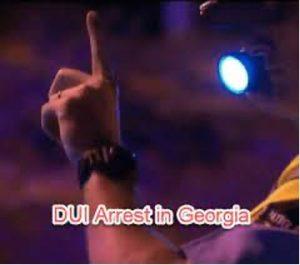
A roadside screening result is not evidence of a blood alcohol number. Police still use it to justify arrests. That gap is where much of the defense work happens.
Several points can be examined. Whether the officer had a lawful basis for the stop. Whether the roadside screening number leaked into testimony or a report in a way Georgia law does not permit. How the field evaluations were given, measured against the training standard. Whether the state-administered test followed the required procedure, including the two-sample rule.
William C. Head, PC focuses on DUI defense in Georgia courts. Partner Cory Yager previously served as a police officer in Roswell and in Cobb County. That background gives the firm a working familiarity with how roadside investigations are conducted and documented. Larry Kohn defends DUI cases, criminal matters, and traffic charges across Georgia. William C. Head has written on DUI defense, including the book 101 Ways to Beat a Drunk Driving Conviction. Defense teams also rely on published research about the standardized evaluations. That includes work by Dr. Spurgeon Cole, a retired clinical psychology professor.
No attorney can promise a particular outcome. Every case turns on its own facts. What can be challenged in one case may not exist in another.
I was referred to William Head because I am out of state. I am young, had many questions, and was very concerned. He treated me as a person, not just another case.
Past results do not guarantee a similar outcome. Every case is different, and results depend on the specific facts.
Some drivers blow into a handheld at the roadside and then take a second test at the station. The details of both tests matter. A free consultation with William C. Head, PC covers what the officer could lawfully report from the screening test. The consultation also covers how the station instrument was operated and what the record shows.
A few details help at that first meeting. The first two are the citation and the date of arrest. The third is whether an officer read an implied consent notice. The fourth is whether a second test was given at the station. The fifth is whether anyone offered an independent test.
One deadline is genuinely time-sensitive. A license may face an administrative suspension. The driver then has 30 days to request a Department of Driver Services hearing. The same 30 days apply to electing an ignition interlock limited permit. That window runs quickly.
A call to (404) 567-5515 reaches a Georgia DUI lawyer who can discuss your breath test. No attorney can guarantee a result. Every case depends on its own facts.


PBT stands for preliminary breath test. Many officers say portable breath test instead. The two terms describe the same handheld screening device. Reports and bodycam audio may also call it a roadside screening device or a handheld. The device is a screening tool, not the evidentiary instrument used after arrest.
A roadside screening result cannot be used as evidence of a blood alcohol level in Georgia. Under Georgia law, that result is admissible only on whether alcohol was present or absent. The officer may testify that the screening test was positive for alcohol. The number displayed on the handheld cannot prove blood alcohol concentration. Georgia courts have applied that limit even at pre-trial motion hearings.
A driver does not have to take the roadside handheld breath test. That screening test is voluntary in Georgia. Declining is not the implied consent refusal, because that request comes later, after a lawful DUI arrest. Drivers who prefer not to test may decline politely and ask to speak with a lawyer.
A breath test estimates blood alcohol indirectly. The device measures alcohol in exhaled breath. An assumed partition ratio then converts that reading, and the ratio does not fit every person equally. Mouth alcohol, breath temperature, and breathing pattern can all move the result. So can absorption timing and calibration history. Georgia law gives the person tested the right to an independent chemical test at their own expense.
Refusing the state-administered test after a lawful DUI arrest can suspend a driver's license for at least one year. The driver has 30 days from the notice to respond. One option is a written hearing request to the Department of Driver Services, with the $150 filing fee. The other option is an ignition interlock limited permit, elected within those same 30 days. That election waives the hearing.